The karmic numerology looks in your date of birth and name for traces of past lives — for lessons you supposedly brought from previous existences and that you are seeking to integrate in this life. It is an extension of the classical Pythagorean tradition, influenced by Eastern karma concepts and Western reincarnation teaching. This app identifies your karmic burdens and lessons.
Karma in numbers
The Sanskrit word karma means "act, effect, consequence". In Buddhism and Hinduism it describes the universal law that every action has consequences that can stretch across several lives. Karmic numerology takes up this idea and looks in the numbers of your date of birth and name for missing or recurring patterns read as hints of past life experiences.
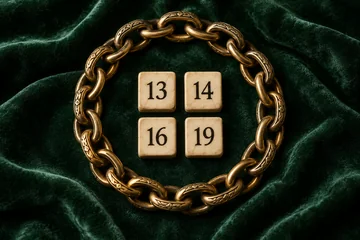
Concretely, karmic numerology works with two main concepts: the karmic debts (specific numbers like 13, 14, 16, 19 that count as "burdened" karma indicators) and the karmic lessons (numbers between 1 and 9 that do not appear in your name — as lessons you should learn in this life). This calculation gives you a profile of what you are working on karmically.
The karmic debts
Four numbers are considered "karmic debts" in Western karmic numerology because they are sums that point to specific life tasks: 13 (1+3 = 4) — lesson of discipline, often as karma from a past life of laziness; 14 (1+4 = 5) — lesson of moderation, karma from excessive living; 16 (1+6 = 7) — lesson of humility, karma from arrogance; 19 (1+9 = 1) — lesson of leading others without ego, karma from abuse of power.
When your life path, birthday or another main number falls on 13, 14, 16 or 19 (before reduction), you carry, by tradition, a karmic burden in that dimension. That does not mean "punishment" — it means life task. Karmic debts are the themes on which your soul wants to grow. Whoever ignores them experiences them as recurring obstacles; whoever accepts them experiences them as life teachers.
Using karmic numerology productively
- Identify your missing numbers. Which numbers 1 through 9 do not appear in the letters of your full birth name? Those are your karmic lessons — the energies you should cultivate in this life because they were not "innate".
- Live your karmic debt consciously. Whoever carries 13-karma (discipline) often experiences chaotic phases in life until they learn structure. Instead of fighting that, you can accept it — disciplined practice (sport, meditation, regular work) becomes karmic healing.
- Compare karmic themes with your past lives reading. Karmic numerology is abstract-mathematical; the past lives test is narrative-pictorial. Both should yield a consistent picture — if not, the discrepancy itself is informative.
- Accept that karmic work is slow. Karma in the numerological sense is no button you press to solve the problem. It is a life task — years, decades. Whoever approaches it with patience experiences gradual liberation; whoever seeks fast solutions runs back into the same themes again and again.
FAQ
Does karmic numerology believe in reincarnation?
It makes belief in reincarnation compatible with numerology, without strictly requiring it. Whoever believes in reincarnation reads the karmic debts as traces of past lives. Whoever does not can read karmic themes secularly — as predispositions to be integrated in this one existence, without metaphysical background. The calculation and practice work in both readings.
Why precisely 13, 14, 16 and 19 as karmic numbers?
The selection comes from the modern Pythagorean tradition, essentially shaped by Florence Campbell and Hans Decoz in the 20th century. The logic: these numbers combine energies historically connected with karma themes (e.g. 13 carries the 1 = self-determination and 3 = expression — karma of "wasted independence"). Other numerological schools name other or additional karmic numbers — the tradition is not fully unified.
What is the difference between "karmic debt" and "karmic lesson"?
A karmic debt is a specific burden that your date of birth or destiny name shows (e.g. 13 in your life path). A karmic lesson is a missing number in your name — an energy you were not "given" and should actively learn in this life. Debts are the past you integrate; lessons are the future you acquire.
Can I "work off" karmic debts?
Not in the sense of paying down a debt, but in the sense of integration. Karma is not a debt balance that goes down, but a task whose acceptance changes you. Whoever takes on 14-karma (moderation) and learns to live measuredly does not "delete" the karmic number from his date of birth — but he becomes a person for whom this lesson is no longer a burden. Karma is transformed through awareness, not paid off.
Related