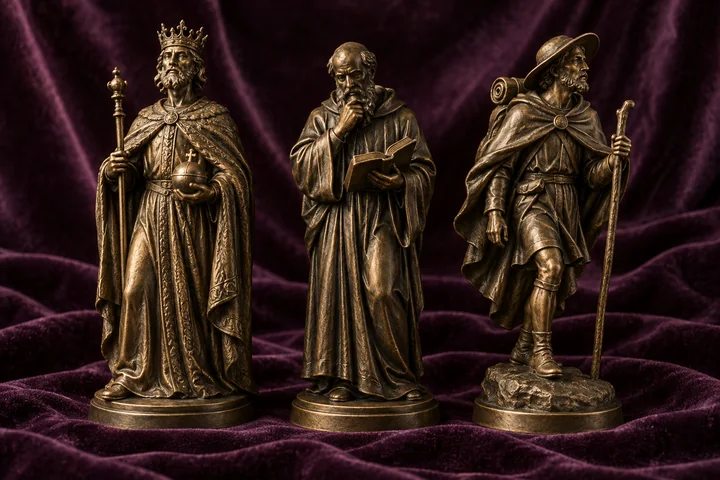
C.G. Jung described the archetypes as primordial psychic figures dwelling in every person — the Hero, the Sage, the Magician, the Lover, the Shadow. Which of them shapes you most strongly says more about your life dynamic than any personality grid in HR. This test asks you 12 carefully chosen questions and identifies your dominant Jungian archetype — with AI-supported evaluation that follows patterns rather than scores.
What archetypes actually are
Jung's theory is more subtle than internet memes suggest. Archetypes are not personality types you belong to, but energy patterns present in every person. What differs is the dominance: in some, the Hero steps forward; in others, the Sage or the Lover. Which energy leads shapes your life decisions, your relationships, your recurring conflicts.
The test does not measure "am I a Hero or a Sage?", but rather "which archetypal energy is currently in the foreground of my life?" That answer can shift across life phases — the Hero of your twenties often becomes the Sage of your sixties. That is not a change of identity, but a shift in inner hierarchy.
The twelve most common archetypes
The Jungian tradition (refined by Carol S. Pearson and James Hillman) names twelve principal archetypes: The Innocent (trust, optimism); The Orphan (belonging, realism); The Hero (courage, proving); The Lover (devotion, connection); The Explorer (freedom, search); The Rebel (liberation, disruption); The Creator (vision, expression); The Jester (joy, play); The Sage (understanding, truth); The Magician (transformation, connection); The Ruler (responsibility, order); The Caregiver (compassion, protection).
Important: every archetype has a shadow side. The Hero becomes the tyrant, the Sage becomes the cynic, the Lover becomes the clinger. To know your own archetype also means recognizing its shadow form — and that is the actual psychological work Jung had in mind.
What to do with the result
- Write down three life decisions that confirm your archetype. If you are a Hero, which three moments were Hero moments? That makes the abstract category concrete.
- Identify your shadow archetype. Which archetype is the exact opposite of your dominant one? For the Hero, often the Caregiver; for the Sage, often the Jester. What do you reject about that energy?
- Observe your language for a month. Which words do you use often? Hero language ("fight, push through, achieve"), Sage language ("understand, think through, clarify"), Magician language ("connect, change, transform"). Language betrays the archetype.
- Read a novel in which your archetype is the main character. Hesse for the Sage, Tolkien for the Hero, Atwood for the Rebel. Literature brings archetypes alive far beyond test results.
FAQ
Am I only a single archetype?
No, you are all twelve — but not in equal strength. The test identifies your dominant energy, leading in your current life phase. You will probably also recognize yourself in the secondary and tertiary archetypes. Some people are "Hero with strong Magician undertone", others "Sage with Jester coloring". These mixtures make the personality.
Does my archetype change over the course of life?
Yes — Jung himself described individuation as a life task in which different archetypes successively take the lead. The first decades are often Hero- or Lover-dominated (departure, bonding). The middle years often shift toward Creator or Ruler (contribution, responsibility). Late years tend toward Sage or Magician (understanding, letting go). If you retake the test in 10 years, the result may differ — and that is good.
Is the test scientifically validated?
In the strict sense, no. Jung's archetype theory is phenomenological, not statistical — it was developed from dreams, myths and therapeutic experience. Empirical personality psychology works rather with models like the Big Five. The value of the archetype test lies not in psychometric accuracy, but in narrative resonance: it gives you a language for talking about your life that is more personal than "extraverted with high agreeableness".
Which archetype is "the best"?
None. Jung explicitly emphasized that all archetypes are equal — every human community needs Heroes, Sages, Lovers, Jesters. Marketing books (Margaret Mark, Carol Pearson) have commercialized archetypes for branding and at times hierarchized them; that is a flattening of the theory. In depth psychology there are no better or worse archetypes, only ones lived more or less consciously.
Related