Try Biorhythm Calculator now for free. Online reading with AI interpretation in seconds, no signup required.

The biorhythm is the thesis that every person, from the day of birth, runs through three biological cycles: a physical one (23 days), an emotional one (28 days) and an intellectual one (33 days). This app calculates where you stand today in each cycle — at the high, at the low or at the critical crossover. The concept is contested, but as a journaling tool for self-observation surprisingly useful.

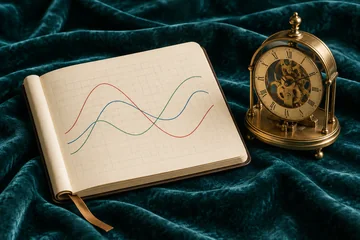
Three waves swinging since your birth

The idea comes from the Berlin physician Wilhelm Fliess (1858-1928), a close friend of Sigmund Freud. Fliess observed patterns in his patients that he traced back to two basic cycles (23 days and 28 days). In the 20th century, Hermann Swoboda added the intellectual cycle of 33 days. The Japanese school (Kohachiro Tomimatsu) made it from the 1960s onward into a popular application in industry and schools.

Each cycle is a sine wave: positive half (high), negative half (low), two "critical days" per cycle (zero crossings) at which the energy switches. The biorhythm claims that these waves keep swinging precisely from the moment of birth onward — independent of age, health or life circumstances. That, however, is also the scientific weak point of the theory: empirical investigations have not been able to reproduce the claimed effects.

What the three cycles promise

Physical cycle (23 days): energy, stamina, resistance, coordination. At the high you feel strong, sporty, illness-resistant. At the low: tired, more susceptible to colds, heavy limbs. Classical application: schedule competitions, surgeries, demanding journeys in high phases.

Emotional cycle (28 days): mood, sensitivity, intuition, sociability. At the high optimistic, sociable, creative. At the low introverted, irritable, melancholic. Application: schedule difficult conversations, creative projects, romantic initiatives in the high phases. Intellectual cycle (33 days): concentration, learning, logical thinking, memory. At the high clear, analytical, learning-ready. At the low diffuse, forgetful, error-prone. Application: important exams, complex contract negotiations, technical decisions in high phases.

Sensible use of the biorhythm

FAQ

Is the biorhythm scientifically proven?
No, not in the strict sense. The largest investigations (Hines 1998, Williams 1993) were unable to reproduce the claimed correlations. What does empirically exist are actual biological cycles — the circadian rhythm (24 hours), the female menstrual cycle (~28 days, which explains the similarity to the emotional 28-day cycle), seasonal rhythms. But the specific 23/28/33-day cycles that swing precisely on from birth are a hypothesis without strong evidence.
Why is the biorhythm so popular then?
Because it is simple, predictable and consoling. It supplies an explanation for days when we feel bad without an obvious reason ("ah, physical low day"). It gives a structure to the otherwise chaotic ups and downs of life. That function is real and valuable — even if the claimed mechanism is not. Many people today use the biorhythm precisely that way: as a pragmatic self-observation tool without metaphysical claim.
What are "doubly critical days"?
Days on which two or three cycles cross their zero line simultaneously. Statistically, doubly-critical days happen about every 1-2 months, triply-critical days about every 6-7 months. In biorhythm belief these are the most unstable days — supposedly elevated risk of accident and illness. Scientific investigations could not confirm this. Whoever observes themselves with unusual care on doubly-critical days, however, can gain self-knowledge.
How does the biorhythm differ from astrological transits?
The biorhythm works with three fixed cycles from the moment of birth, with no reference to external celestial bodies — it is a closed inner mathematics. Astrological transits work with the actual movements of the planets relative to your natal chart. They are much more complex (10 planets at many speeds), take into account the cosmic outer world, and are felt by their followers as richer.

Related