Halomancy

The Oracle of Salt

From ancient Rome to the Near East, salt has been the link between humans and the divine. Its patterns, as they fall, reveal messages from the cosmos. Focus on your question and let the crystals speak.

Try Alomancy now for free. Online reading with AI interpretation in seconds, no signup required.

Alomancy or halomancy is divination with salt — one of the oldest documented divinatory practices in Europe, with roots in classical Rome and traces in Iberian folk tradition to this day. You throw salt onto a surface, observe the pattern, and read from it the answer to your question. This app uses a modern adaptation: you describe the question, and the AI generates a simulated salt-pattern reading.

Salt — the substance that had magic before it was a spice

In antiquity, salt was valuable enough to serve as wages — the Latin salarium is the root of our "salary". It was a symbol of purity, permanence, protection against evil spirits. The alomantic tradition arose from this symbolic charge: salt could show the future because it itself stood between worlds — earthly substance with otherworldly meaning.

It was practiced in classical Rome (Aulus Gellius describes it), in Arab folk tradition, in medieval Europe. In Spain the practice survived into the 20th century in rural brujeria blanca (white witchcraft) — grandmothers who gave answers with a handful of salt on a dark cloth. Today the practice is largely forgotten, but as a historically authentic divinatory method it is remarkably well documented over a long span.

How salt patterns are read

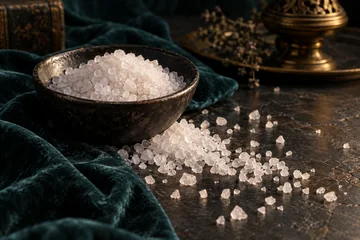
You throw a handful of coarse salt from about 30 cm above onto a dark surface (classically: black cloth or slate board). The pattern is read in four quadrants: top left (past), top right (future), bottom left (inner world), bottom right (outer world). The distribution of salt across these quadrants reveals where the answer comes from.

The shape of the clusters is interpreted: cross (conflict), spiral (growth or danger depending on direction), line (clear answer), scattering (unclarity), accumulation in one place (concentration of the energy there). The color intensity also plays a role — dense white areas are "full of energy", sparse areas are "empty". An experienced alomant reads in 1-2 minutes what the pattern says.

If you want to try alomancy

  • Use coarse sea salt, not table salt. Fine salt flows too evenly and leaves no recognizable patterns. Coarse sea salt forms the characteristic clusters and scatterings.
  • A black surface is mandatory. On a white background the salt is invisible. Classically a black cloth is used; alternatively a dark tray or a slate board.
  • Ask the question aloud before throwing. Tradition says that the salt "carries" the question spoken into the room and answers it in its pattern. Silent questions supposedly work less well.
  • Read slowly. Unlike the I Ching, which delivers a clear text, alomancy is projective — you must see what is in the pattern. That perception does not come immediately. Sit 5-10 minutes with the pattern, observe it from various angles. What seems chaotic at first often arranges itself on second look.

FAQ

Why is alomancy so little known compared with tarot or I Ching?
For several reasons. First: it has no written standardization — tarot has books, the I Ching has Wilhelm's translation, alomancy was passed orally from grandmother to granddaughter. Second: it requires physical equipment (salt, dark cloth) and a practice not "spiritual market"-suitable. Third: many European folk traditions were forgotten in the 20th century, replaced by imported (Eastern, Anglo-American) practices. Alomancy is exactly that quiet European layer.
Does the digital variant work like the real throwing?
Differently. The app generates a simulated pattern and delivers a reading — that is an approximation, not a substitute. Whoever seeks the real experience must take salt and cloth in hand. The app is an introduction to the symbolism and a quick answer when the physical ritual is currently not possible.
How does alomancy differ from <a href="/mantik/kapnomantie">capnomancy</a>?
Both are pattern-recognition divinations: a chaotic medium (salt, smoke) generates patterns to be read. Salt is static (it lies there, you can look for a long time), smoke is dynamic (it moves, changes, you must read in the moment). Both use the same psychological mechanism (projective perception), but the experience is different — salt is more meditative, smoke is intuitive-quick.
Does throwing salt at the table (against bad omens) have anything to do with this?
Yes, the same tradition. "If you spill salt, throw a pinch over your left shoulder" is the protective variant: the spilled salt is supposed to have woken bad omens, the thrown salt drives them away. These folk customs are the everyday remnants of the once-rich alomantic tradition. Alomancy as divination is the ritualized variant; throwing salt over the shoulder the domesticated, secularized one.

Related