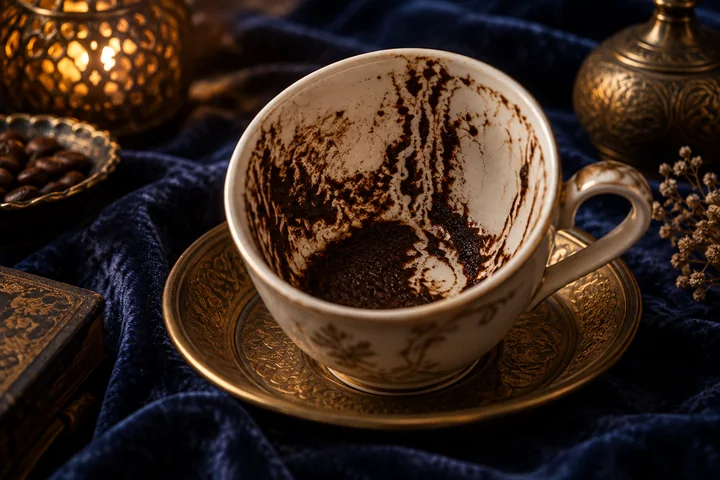
You drink a cup of Turkish coffee. Turn the cup over, wait a moment — then read the remaining pattern of coffee grounds. That is how tasseography works, the reading from coffee grounds, an old practice from the Ottoman world that is still alive throughout the Levant, in Greece and the Balkans. This app does not replace the ritual; it interprets a photo you take — you photograph the cup, the AI reads the symbols.
A practice alive since the 16th century
When coffee conquered Europe in the 16th century from Yemen by way of Istanbul, a divinatory practice came with it: fal-i kahve, the reading of coffee grounds. In Ottoman coffeehouses it was the women's domain — the men drank, the women read the cups. In Greece it is called kafemandeia, in Bosnia fildzan. The practice is still alive in families today — almost every Turkish, Greek or Lebanese grandmother knows it.
The method is the same everywhere: strong, unsweetened coffee in a small cup, drunk slowly down to the last sip, which should pick up the grounds. Cover the cup with the saucer, turn it three times clockwise, invert it, wait a minute. Then lift it — the pattern in the grounds is read like a picture. Clouds? Animals? Letters? Each symbol has a meaning in the context of the question.
Which symbols mean what
The standard symbolism has been relatively stable for centuries: birds (messages), fish (luck, wealth), snakes (caution, conflict), trees (growth, family), houses (home, security), ships (journey), keys (solution in sight), hearts (love), crosses (burden), flowers (joy), letters (initials of an important person).
The position matters as much as the symbol. Symbols at the rim concern the present, symbols at the bottom the distant future. Symbols near the handle concern you personally, symbols opposite the handle other people. Light symbols (little grounds) are favorable, dark ones (dense grounds) more difficult. A complete reading integrates symbols, positions and density.
What to bear in mind
- Use real Turkish or Greek coffee. Filter coffee or espresso leaves hardly any grounds. The fine powdery grind of Turkish coffee is essential to the method — it creates the fine patterns that get read.
- Ask a question before drinking. Tradition says: the ritual begins with the question, not with the drinking. Whoever drinks without a question and then turns the cup over gets a random image with no reference.
- Trust the first perception. The first impression — "that looks like a bird" — is usually the right reading. Whoever stares too long begins to invent symbols that are not there.
- Read with someone else. Classically, coffee-ground reading is a social practice. A second person often sees symbols you missed — and delivers a second layer of reading. The app does not replace that, but it complements it for moments when no one is sitting beside you.
FAQ
Does the app work without proper Turkish coffee?
Hard. The photo needs a recognizable grounds pattern — and that only exists with traditionally prepared finely ground coffee that leaves grounds. Espresso remnants or filter-coffee crumbs are too sparse for a reading. Anyone wanting to try the practice seriously should buy Turkish or Greek coffee (e.g. Kurukahveci Mehmet Efendi, Loumidis) — costs little, worth it for the experience.
Is coffee-ground reading really a tradition or just folklore?
Genuinely traditional — and folkloric at the same time. It has been documented since the 16th century in Ottoman sources, was fashionable in Viennese coffeehouses in the 18th and 19th centuries, and is still living family practice in Greece, Turkey, the Levant and the Balkans. "Folklore" and "real tradition" are not opposites: what generations live is both. The AI variant in this app is the modern extension — it does not replace the grandmother, but it makes the tool accessible when no grandmother is at hand.
What if I do not see clear symbols?
That is normal — coffee-ground reading is a projective practice. What you see is connected to your inner state. Whoever is currently thinking about travel sees ships more easily; whoever has relationship worries sees snakes or hearts more easily. This projection is not "wrong" — it is part of the method. What you see says something about what your soul is currently occupied with. The AI in the app delivers a second reading for comparison.
How does tasseography differ from the <a href="/orakel/die-kristallkugel">crystal ball</a>?
Both are projective divinations — you look into a medium and see images that your intuition formulates. Tasseography uses the concrete (grounds patterns), the crystal ball uses the abstract (refractions of light). Tasseography is mostly social practice (with cup, tea, conversation), the crystal ball mostly solitary meditation. Tasseography is everyday-near (you make coffee anyway), the crystal ball is more ritual. Both work with the same psychological mechanic.
Related