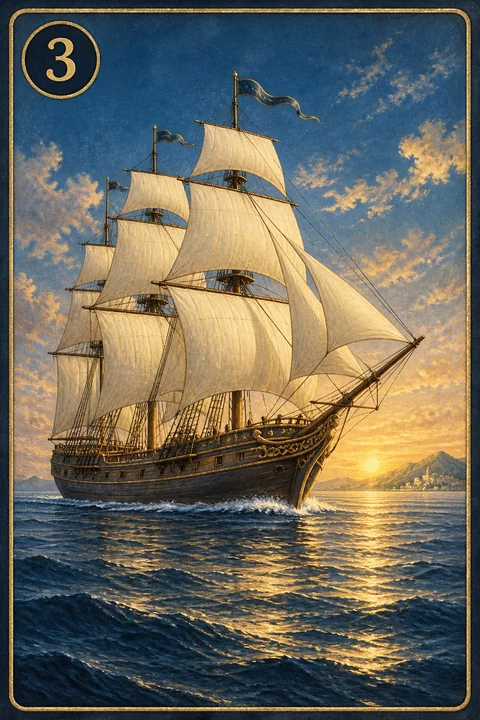
The Belline Oracle is one of the most elegant and oldest French divinatory decks — created around 1865 by the clairvoyant Magus Edmond, later rediscovered and popularized by the legendary Parisian seer Belline (Marcel Belline, 1920-1998). 53 cards with rich symbolic motifs deliver a divinatory system with depth of its own. This app draws a card for your question and delivers the AI reading.
Three layers of history
The original version comes from Magus Edmond, a Parisian clairvoyant of the 19th century (his civil name was Edmond Billaudot, 1822-1881). He combined traditional cartomantic symbols with astrological, kabbalistic and tarot elements into a unique set. After his death the deck fell into oblivion — until almost a hundred years later Marcel Belline found it in a Parisian antiquarian shop, used it again and connected it with his famous clairvoyant practice.
Belline's career is part of modern esoteric history: he read cards for personalities from Edith Piaf to Jean Cocteau, was a media phenomenon on French television and gave the deck its current name. Today the Belline Oracle is especially popular in the French-speaking world; less known in the English-speaking, but valued by connoisseurs for its symbolic richness.
Seven planets as structuring code
The Belline deck is structured around the seven classical planets of ancient astrology: Sun, Moon, Mercury, Venus, Mars, Jupiter, Saturn. Each planet has seven assigned cards plus a central main card — in total 7x7+4 additional = 53 cards. When your reading contains many cards of one planet, that planet's energy dominates: many Mars cards = conflict or initiative, many Venus cards = love and beauty, many Saturn cards = limitation or maturity.
The individual cards combine visual symbols (anchor, star, castle, ship, sword, crown) with text labels (often in French in the original deck). That makes them very accessible: unlike with tarot, you do not need extensive symbol knowledge, because the cards say their main meaning in a word. This directness opened the deck in the 20th century to a broad audience.
How to get the best out of the Belline Oracle
- Begin with single-card readings. One card per question, clear and direct. Expand to spreads (3, 5, 7 cards) only when you know the deck well.
- Pay attention to the planetary distribution. Which planet dominates? That gives you the main energy of the answer, regardless of the specific card content.
- Get to know French vocabulary. Original Belline cards have French inscriptions — "Voyage", "Amour", "Argent", "Maladie". That is part of the atmosphere of the deck. Whoever learns French in parallel gains an extra layer.
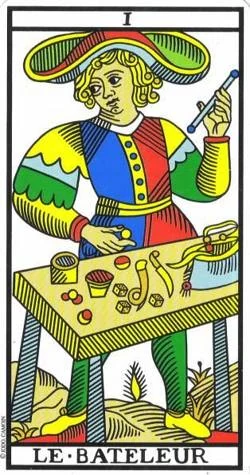
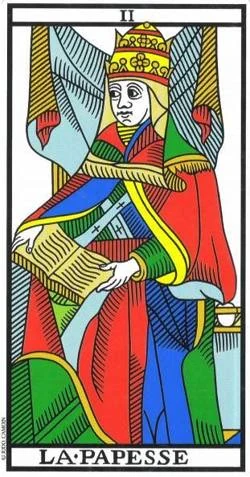
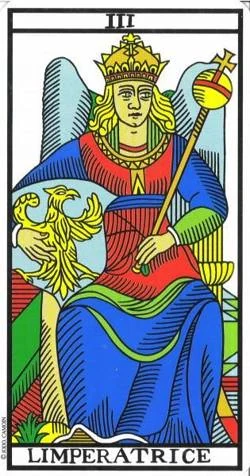
- Compare with the Marseille tarot. Both are French divinatory traditions from a similar era. Whoever uses both sees the conventions of French esotericism in two different forms — tarot is symbolic-archetypal, Belline is more concrete and everyday.
FAQ
Who exactly was Marcel Belline?
Marcel Belline (1920-1998) was one of the most famous French clairvoyants of the 20th century. Born in Marseille, he came to Paris after the Second World War and became the seer of the artistic scene and the high society. Edith Piaf consulted him, as did Jean Cocteau, Marlene Dietrich, later Yves Saint Laurent. He was present on French television, wrote several books (among them "La Troisieme Oreille", 1972) and shaped the image of the "mediumistic clairvoyant" of postwar French culture.
How does Belline differ from <a href="/tarot/lenormand-tarot-antwortet">Lenormand</a>?
Both are 19th-century decks from the French-German area with symbolic (not figuratively narrative) imagery. Lenormand has 36 cards and is methodically combination-based (cards are read in pairs or lines). Belline has 53 cards and is stronger as single cards (each card has a sufficiently rich meaning to be read alone). Lenormand is everyday-pragmatic, Belline poetic-multivalent. Both are valid; they appeal to different temperaments.
What are the most famous Belline cards?
A few cards have particular weight in the tradition: Le Pot aux Roses (revelation of secrets), L'Arbre de Vie (growth, family), Le Bouquet (positive gift, luck), L'Ancre (stability, long stay), Le Serpent (caution, deceit). When these cards turn up in your reading, they count as "heavyweight" cards whose message deserves special attention.
Does Belline work better for certain themes?
It is universal, but the French tradition recommends it especially for
fateful life questions — major turns, romantic entanglements, artistic and creative themes. For very everyday practical questions,
Lenormand is often more direct. For deep spiritual or philosophical questions, the
Marseille tarot or
I Ching is often more fitting. Belline has its strength in the middle zone — serious, but not academic-symbolic.
Related