Velomancy

The Art of Reading Flames

Light the sacred candle, silently formulate your question and observe how the flames reveal the messages of the universe.

Try Candle Reading now for free. Online reading with AI interpretation in seconds, no signup required.

Ceromancy (also called velomancy) is divination with candles — through observation of the flame, the wax, the smoke. An old folk practice still alive in Mediterranean countries, Latin America and Celtic regions. This app uses an adapted variant: you describe what you observe in the flame, and the AI interprets the signs for your question.

Three things a candle can say

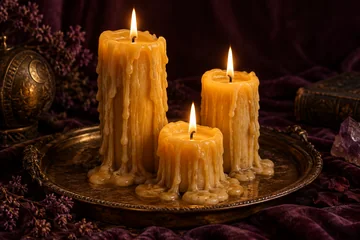
A burning candle produces three things to observe: the flame itself (its behavior, its height, its color), the smoke (direction, density, shape) and the melting wax (drop shape, distribution, hardening). Each of these three aspects has its own symbolic language in ceromancy.

The tradition comes from several roots: Roman auspices (the observation of omens), Christian candle rituals, Mediterranean folk magic. In Italy the practice is called ceromanzia, in Spain velomancia; in Latin American curandero traditions it is integral to healing rituals. It is often combined with other practices — prayer, smudging, divination with cards or coins.

What flame, smoke and wax reveal

The flame: tall and straight = clear answer, positive energy; low and weak = negative or unclear energy; flickering without wind = unseen presence, caution; crackling or whistling = someone is talking about you; suddenly extinguished = clear "no" or ending; tinted blue = traditionally read as spiritual presence.

The smoke: going upward = favorable, wish granted; downward = unfavorable, difficulty; circling = confusion, clear sight only later; to the left = past is the main theme; to the right = future. The wax: in straight drops = clear path; in lateral streaks = obstacles; hardening into the shape of symbols (heart, cross, animal) = the symbol's meaning applies to the question. Classical ceromancers read all three aspects at once.

Practicing ceromancy safely and meaningfully

  • Mind fire safety. Sounds banal, but it is important: never leave candles burning unattended, always on a fireproof surface, away from curtains and paper. Ceromancy is a calm practice, not an emergency — afford yourself the safety.
  • Choose beeswax or pure paraffin candles. Scented candles, dyed candles or those with glitter have additives that produce a more chaotic burning behavior — the flame is less "readable". A simple white candle is classical.
  • Ask the question once clearly, then be silent. Whoever continues to talk or think during the observation projects into the flame. Ask the question at the start, then sit still and observe for 5-10 minutes.
  • Note your observation immediately. What you see in the flame shifts in retrospect through memory. A short journal (date, question, observation, reading) makes your practice instructive over months.

FAQ

What does it mean if the flame suddenly goes out?
Classically this is a strong "no" or a hint of a closed phase. In some traditions it is read as the presence of a spirit who "blows out" the flame. Practically it is often a draft or a wick effect — the symbolic reading depends on whether you take the tradition magically or psychologically. What you should do: ask the question in another form or repeat the ritual later, when the energy is calmer.
Which candle color is best?
Tradition assigns colors thematically: white for general questions and protection, red for love and passion, green for money and health, black for protection and cleansing (not "evil"!), blue for peace and truth, yellow for clarity and concentration, purple for spiritual questions. If you have a specific question, choose the thematically fitting color; for general ceromancy white is enough.
How does ceromancy differ from <a href="/mantik/kapnomantie">capnomancy</a>?
Capnomancy reads only the smoke — usually from incense or fire, not from candles. Ceromancy is more comprehensive: flame, smoke and wax are all read. If you are primarily interested in smoke shapes, capnomancy is purer. If you want to use the full spectrum of a burning candle, ceromancy is richer. In practice the two often overlap.
Does ceromancy have a Christian background?
It is pre-Christian in its roots (Roman auspices, Mediterranean folk magic), but was carried on through the Christian Middle Ages and folk piety — candles are central to the Catholic rite, after all. In Latin American curandero traditions, ceromancy today is often connected with Catholic iconography (candles before images of saints, reading combined with prayer). It works, however, regardless of religious affiliation — the symbolic language is universally human.

Related