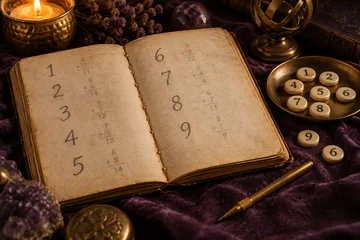
The arithmomancy (from Greek arithmos = number, manteia = divination) is the direct questioning of numbers as an oracle — without detour through your date of birth or personality name. You formulate a question, the app generates on the basis of numerological resonance an answer-number between 1 and 9, and the AI interprets that number as an answer to your question. It is numerology in its rawest, most oracular form.
Numbers as direct language
Where life-path numerology calculates your life profile, arithmomancy questions the current moment. It treats numbers like I Ching hexagrams or tarot cards: every number has an answer, and the question decides what the answer means. It is a very old practice — Pythagoras demonstrably used it, and in the Middle Ages it was practiced in Arab and European esoteric circles.
Methodically, the app works with a mixture of your current date, the resonance of your question (letter counting) and a random element. From this arises a number that — unlike fixed numbers such as the life path — can be different for each question. The number is then interpreted numerologically and in the context of your question.
What the nine answer-numbers say
1: Begin. Take initiative, go forward alone, independence. Yes to new paths. 2: Wait for the other. Relationship, diplomacy, patience. The answer lies in togetherness. 3: Express. Say it out loud, step into visibility, be creative. Joy of life. 4: Build. Structure, discipline, long breath. The answer takes time, but it lasts. 5: Change something. Movement, journey, fresh wind. Holding on would do harm.
6: Take responsibility. Care, home, family. The answer demands devotion. 7: Withdraw. Reflect, research, be silent for a while. The answer is not outside. 8: Manifest. Take power, take material steps, claim results. Maturity. 9: Let go. End, close, forgive. Let what wants to go, go.
How to use arithmomancy meaningfully
- Ask a specific, short-term question. "Should I reach out today?" works. "Will I be happy?" is too vague. Arithmomancy is good for questions with a time horizon of days to weeks.
- Take the first reaction seriously. When the number falls and you inwardly think "ah, yes" or "ah, no" before reading the text — that is the most important information. The number confirms or contradicts your intuitive hunch.
- Do not ask too often. Whoever uses arithmomancy several times a day flattens the tool. One question, one answer, then live with the answer. Numerology rewards economy.
- Write question and answer-number in a journal. Over months you recognize patterns: does the 4 keep coming up? Perhaps life is pointing you to the building theme. Always 7? Possibly you currently need more inner work.
FAQ
Is arithmomancy the same as numerology?
It is a subfield of numerology. Numerology covers everything that connects numbers with personality and destiny (life path, motivation number, etc.). Arithmomancy is the specific oracular application — a number as the answer to a question, comparable to card oracles. Whoever knows numerology already has the vocabulary for arithmomancy — but the application is different (situational rather than personal-structural).
Can I also do arithmomancy with dice?
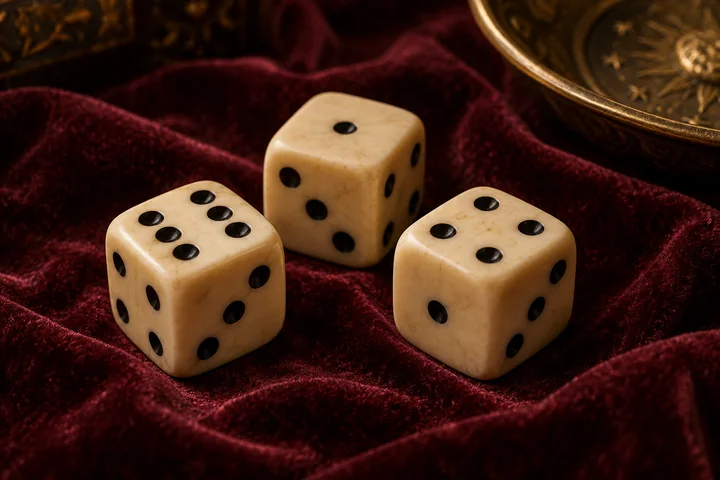
Yes, that is the classical manual method. Three six-sided dice, one throw, sum, reduced to a single digit. If the dice show 4-5-6, for example: 4+5+6 = 15 → 1+5 = 6. Answer-number 6. This method works just like the digital variant. Advantage: the physical throw creates a ritual connection that some find more meaningful than digital generation. Whoever wants to try: three dice are available in any game shop.
How does arithmomancy differ from the <a href="/orakel/i-ging-orakel">I Ching</a>?
Both consult an oracle with a question and receive a symbolic answer. But the symbolic depth differs: the I Ching works with 64 hexagrams, each with detailed commentary — a rich, often complex language. Arithmomancy works with 9 numbers, each with one clear main meaning — more direct, faster, less nuanced. If you need a quick answer: arithmomancy. If you seek rich counsel: I Ching.
Why only 9 numbers and not more?
Because the Pythagorean tradition assumes that all qualitative energies can be mapped onto 9 ground numbers. The number 10 becomes 1 (1+0), 11 becomes 2, 12 becomes 3, and so on. This reduction is not arbitrary — it follows the assumption that the numbers 1 through 9 are the archetypes of all number energies. Some modern schools extend with the master numbers 11, 22, 33, but classical arithmomancy stays with 1-9.
Related