The I Ching or Yijing is the oldest divinatory tool in the world — a Chinese book of changes whose roots reach back to 1000 BCE. This app is the classical variant: you throw digital coins, six lines emerge, a hexagram is built, and you receive the traditional Wilhelm text for it. Fast, without AI interpretation, in the oldest available form. (The AI version is available as I Ching with AI.)
The Book of Changes — briefly explained
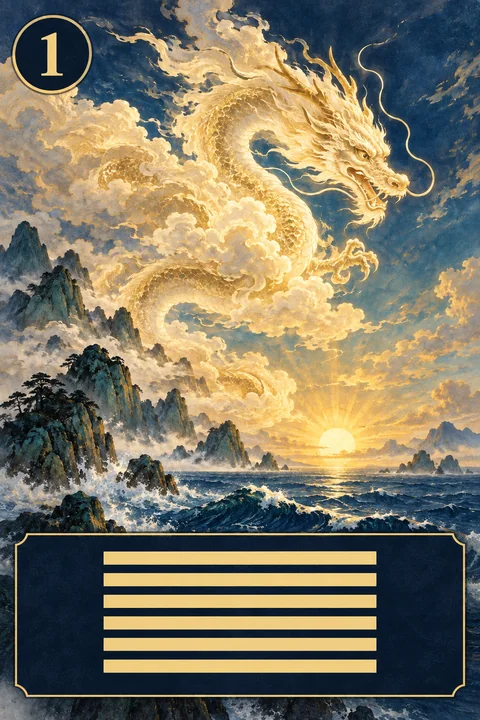
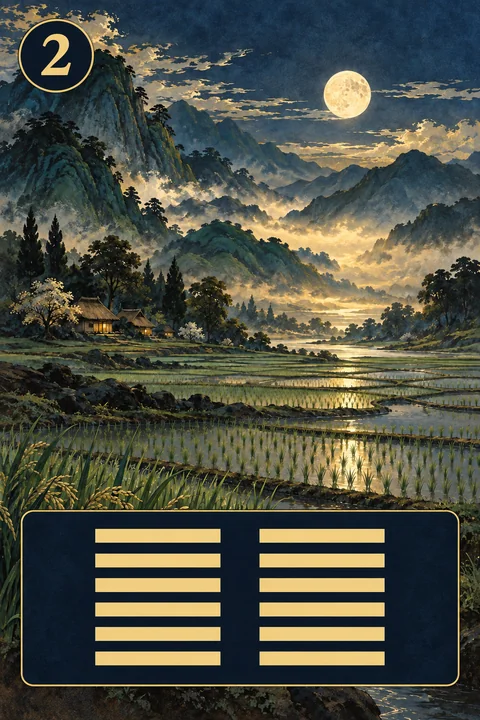
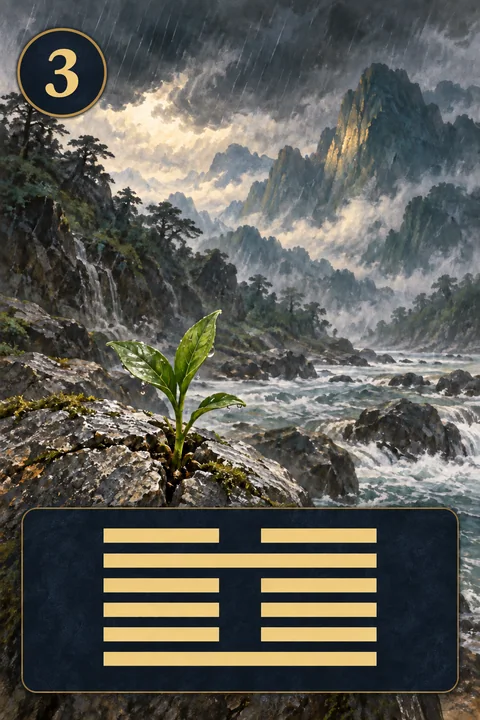
The I Ching emerged in the late Shang or early Zhou dynasty (around 1000 BCE) and has a 3000-year tradition of commentary. At its core it consists of 64 hexagrams — symbols of six lines each, either solid (Yang) or broken (Yin). Each hexagram has a name, a classical text and commentaries on each line.
When you ask a question and throw three coins six times (or the app does it digitally), the six lines of your personal hexagram emerge — one of 64 possible answers. Some lines are "moving" (in change) and lead to a second hexagram describing the tendency. This app delivers the hexagram, the classical Wilhelm text and the line commentaries. For a contextualized AI reading of your specific question, use the I Ching with AI variant.
Eight trigrams as building blocks
Before there are 64 hexagrams, there are eight trigrams (Bagua) — three lines tall, each either Yang or Yin. They are called: Qian (Heaven, the Creative), Kun (Earth, the Receptive), Zhen (Thunder, the Arousing), Xun (Wind, the Gentle), Kan (Water, the Abysmal), Li (Fire, the Clinging), Gen (Mountain, Stillness), Dui (Lake, the Joyous).
Each hexagram arises from two trigrams — a lower and an upper one. 8 x 8 = 64 hexagrams. The name of each hexagram expresses the synthesis: the hexagram "Difficulty at the Beginning" (Hex. 3) arises from Thunder under Water — the energy that pushes through a difficult situation. The hexagram "Peace" (Hex. 11) arises from Earth above Heaven — the exchange of the natural hierarchy, paradoxically harmonious. This combinatorial depth makes the I Ching an inexhaustible tool.
How to question the I Ching with respect
- Ask a mature question. The I Ching rewards depth. "How do I approach this life situation?" works. "Will I be rich?" will be answered with frustration.
- Read the main commentary first, then the lines. The main commentary on the hexagram is the central answer. Moving lines give nuances.
- Accept a "wait" hexagram. Hexagrams like Hsu ("Waiting") or Pi ("Standstill") recommend patience. Whoever draws them and impatiently throws again disregards the answer.
- Note and return. What seems puzzling on the day of the question often becomes crystal clear weeks later. The I Ching unfolds over time.
FAQ
How does this version differ from <a href="/tarot/das-i-ging-antwortet">I Ching with AI</a>?
This variant delivers the hexagram and the classical Wilhelm text — no contextualized interpretation of your specific question. It is the pure, traditional reading. The AI variant goes further: it connects the hexagram to your question and delivers a contextualized reading. Whoever sees the I Ching as a spiritual practice and wants to study the original text uses this variant. Whoever seeks a concrete life application uses the AI variant.
Who was Richard Wilhelm?
Richard Wilhelm (1873-1930) was a German sinologist and theologian who lived 25 years in China and produced a canonical translation of the I Ching (1924). His Chinese teacher Lao Naixuan accompanied the work. Wilhelm's translation is to this day regarded as the most influential Western I Ching edition — C.G. Jung wrote the foreword to the English translation. His son Hellmut Wilhelm continued the tradition. Wilhelm's translation is not the only one (Stephen Karcher, John Blofeld, Wilhelm Reifler have their own), but it remains the standard.
How do the six lines emerge from the coin throw?
The classical method: three coins are thrown six times. With each throw, heads (3) and tails (2) are counted. Three coins yield sums of 6, 7, 8 or 9. 6 is a moving Yin line (changing to Yang), 7 is stable Yang, 8 is stable Yin, 9 is a moving Yang line (changing to Yin). The six throws yield six lines — read from bottom to top — the hexagram.
What do "moving" lines and the second hexagram mean?
When your hexagram has moving lines (6s and 9s), those lines tip into their opposites and you get a second hexagram — the "transformation hexagram". It shows the tendency, where your situation is heading. Example: Hex. 3 (Difficulty at the Beginning) with a moving third line becomes Hex. 8 (Holding Together). Reading: difficulty now, but tendency toward solidarity. The moving lines are often the most important hints in the entire reading.
Related