☰☷

I-Ging

Das Buch der Wandlungen

0/500

Wähle 3 Hexagramme

0/3 Hexagramme

☰☷☵☲☳☴☶☱

Deine Lesung des I-Ging

Vergangenheit
Gegenwart
Zukunft

Das Orakel wird befragt…

Try I Ching with AI now for free. Online reading with AI interpretation in seconds, no signup required.

The I Ching is not tarot — it is 3000 years older, comes from China and works with 64 hexagrams instead of cards. We have nevertheless placed it here in the tarot section because its function is related: question a symbol, receive an answer, mirror a life theme. This variant uses AI to connect the classical Wilhelm translation with your concrete question — a deeper reading than the quick standard I Ching oracle.

One of humanity's oldest books

The I Ching ("Book of Changes") was composed around 1000 BCE in the late Shang or early Zhou dynasty. Confucius is said to have remarked in old age, "If I were given more years of life, I would devote 50 of them to the I Ching." The book is the sum of a Chinese view of the world: everything in the universe arises from the interplay of Yin and Yang, combined into trigrams that in turn order into 64 hexagrams of six lines each.

In the West, the I Ching became famous through Richard Wilhelm — his German translation appeared in 1924 with a foreword by the Chinese master Lao Naixuan. C.G. Jung wrote the foreword to the English edition and used the I Ching to demonstrate his concept of synchronicity. Today it is one of the most widely read books of wisdom outside its native culture — and our app uses the Wilhelm tradition as its basis.

Eight trigrams that mean everything

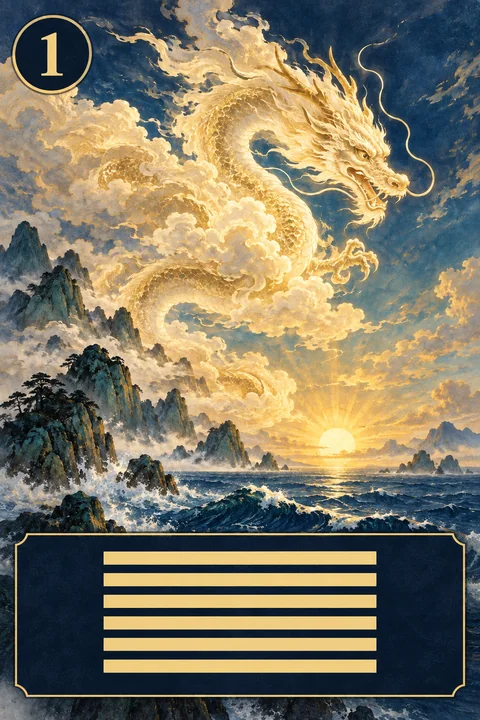
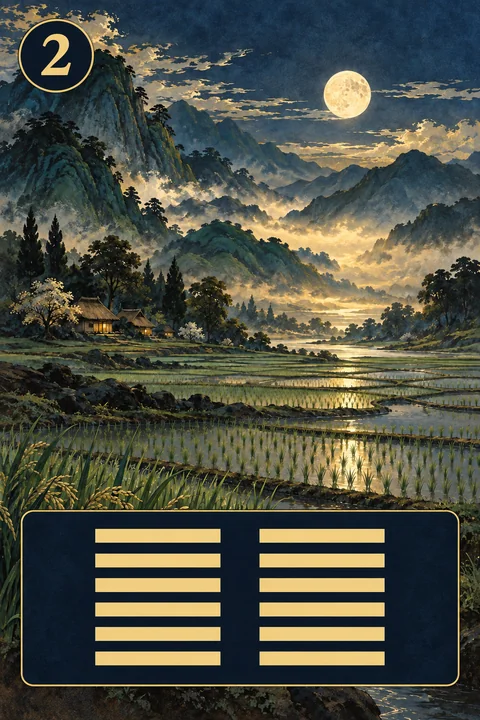
The building blocks of the I Ching are the eight trigrams (Bagua) — three lines each, solid (Yang) or broken (Yin). They are called: Qian (the Creative, Heaven), Kun (the Receptive, Earth), Zhen (the Arousing, Thunder), Xun (the Gentle, Wind), Kan (the Abysmal, Water), Li (the Clinging, Fire), Gen (the Stillness, Mountain), Dui (the Joyous, Lake).

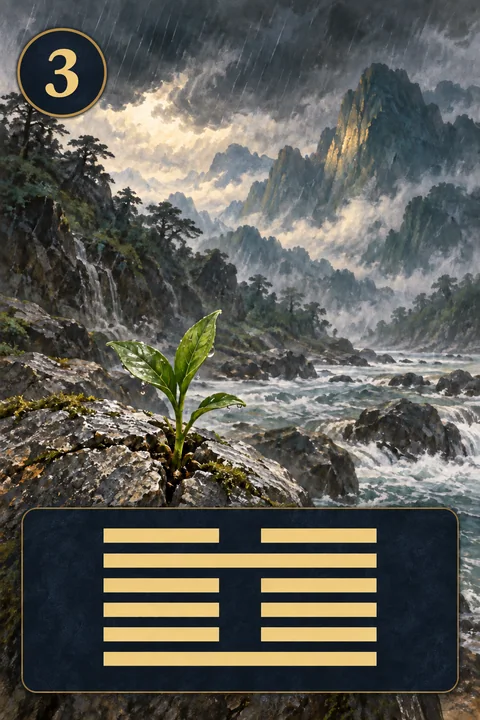
When you ask a question and toss coins (or the app does it digitally), six lines arise — two trigrams that combine into a hexagram. 8 x 8 = 64 hexagrams in total. Each has a name (e.g. "The Creative", "Pushing Upward", "Difficulty at the Beginning") and a classical commentary — the Wilhelm text that the AI uses as its basis. Some lines are "moving" (in change) and lead to a second hexagram describing the tendency.

How to question the I Ching with respect

FAQ

How does this version differ from <a href="/orakel/i-ging-orakel">your normal I Ching oracle</a>?
The standard oracle draws a hexagram and delivers the classical Wilhelm text. This "tarot" variant goes further: the AI connects the hexagram to your concrete question and contextualizes the answer — much as a 3-card tarot reading is more than three isolated card meanings. If you are questioning the I Ching about a life situation, this version is often more helpful; if you only want to study the classical text, the standard variant is purer.
Should I throw coins or use the app?
Both are legitimate. The classical method (three coins, six tosses) is more meditative and connects you physically to the act. The app is faster and uses cryptographic randomness, statistically identical to coin tosses. If you understand the I Ching as a spiritual practice, real coins are worth it (or, traditionally, the 50 yarrow stalks). For a question on the fly, the app is fine. Both methods produce the same hexagram pool.
Why did C.G. Jung value the I Ching so highly?
Jung saw in the I Ching the best practical demonstration of his concept of synchronicity — meaningful coincidences that are not causally linked but inwardly connected. When you ask a question and a hexagram falls that exactly describes your situation, that is, in Jung's view, no coincidence in the trivial sense, but a manifestation of an order that mediates between inner and outer world. This perspective allows a modern, secular approach to the I Ching — as a psychological tool, not necessarily as fortune-telling.
If I do not know Chinese, do I lose the depth?
Somewhat, yes. The Chinese hexagram names carry connotations that shrink in translation — Qian is not only "the Creative" but also "Dragon, Father, Heaven, Movement". Even so, the Wilhelm translation is exceptionally good — he worked on it for decades with Chinese scholars. For 95 percent of practical inquiry, the English text is fully sufficient. If you want to dive deeper, there are modern translations (Stephen Karcher, Hellmut Wilhelm) and Chinese original texts with commentary.
Can the I Ching answer wrongly?
Rather: one can misunderstand the I Ching. Classical teaching holds that the book always answers correctly — only the interpretation can be flawed. Common mistakes: taking the answer literally instead of symbolically ("travel" as actual travel, not as life movement); rejecting the answer because it is uncomfortable; phrasing the question so vaguely that any answer fits. The I Ching is a precise tool that asks for precise questions. Those who consult it with respect almost always get a substantial answer.

Related