Rider-Waite-Tarot

Entdecke die Botschaften, die das Universum für dich hat

0/500

Try Rider-Waite Tarot now for free. Online reading with AI interpretation in seconds, no signup required.

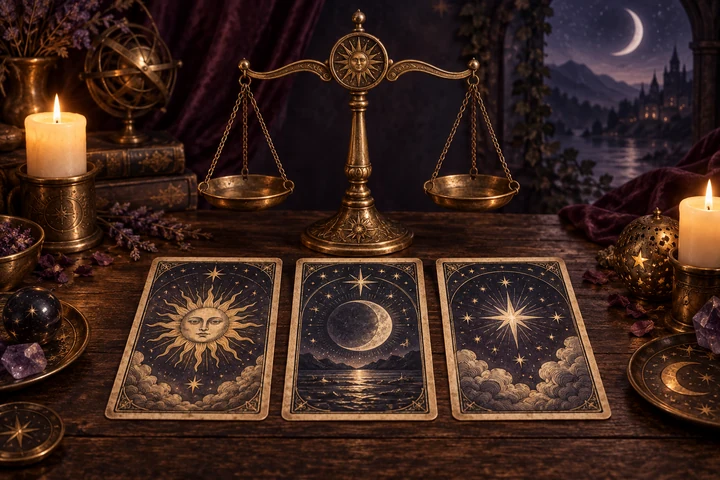
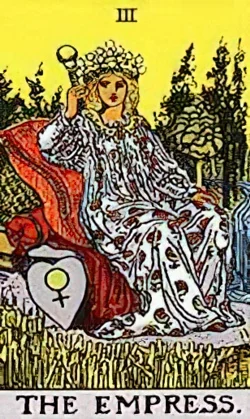
When you picture a tarot deck, you are probably seeing images from the Rider-Waite tarot — even if you do not know the name. The 1909 deck is the most reproduced tarot imagery in history and has shaped how the world has visualized tarot cards ever since. This app lets you draw three cards, and the AI interprets them not by template, but in relation to your question and the interplay among the three cards — the way an experienced reader would.

Why this deck became the standard

In 1909, Arthur Edward Waite and the artist Pamela Colman Smith published a deck that broke with tradition: until then, the Minor Arcana showed only abstract arrangements — three Wands, five Pentacles, seven Swords. Smith painted each of the 56 Minor Arcana as a scene with people, landscape, gesture. Suddenly tarot could be "read" like a picture book, without having to memorize hundreds of keys. That made the deck accessible and exportable — and exported it was, on a massive scale.

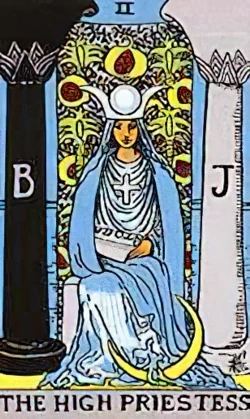
Today, an estimated 80 percent of all modern tarot decks are based on the symbolism Waite and Smith established. Whoever sees the High Priestess here will see a variation on the same composition in any other modern deck. That makes Rider-Waite the lingua franca of tarot: learn these 78 cards and you can read practically any deck on the market. The app you are using right now works with the original 1909 deck.

Three compositional principles that make Rider-Waite unique

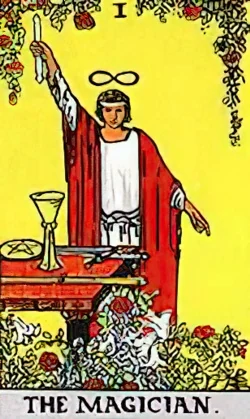
First: golden ratio and mirroring. Smith composed almost every card symmetrically or in 1:1.618 proportion. The Magician, the High Priestess, the Hierophant — all stand exactly centered, frontal. This stillness draws the eye. By contrast, the dynamic cards (the Chariot, the Tower, the Wheel) are explicitly composed against this symmetry — the visual tension itself becomes the content.

Second: color code. Yellow dominates in the sacred cards (Sun, World, Hierophant). Blue in the spiritual ones (High Priestess, Moon). Red in the will cards (Magician, Emperor, Chariot). Once you know this code, you read the statement of a card before you decode the symbols. Third: hidden letters and symbols. Smith was a member of the hermetic order of the Golden Dawn and integrated yods, tetragrams and Hebrew letters into the images. Beginners miss much of it — and that is what makes the deck inexhaustible.

How to get the best from an AI reading

FAQ

Does tarot reading really work, or is it just intuition?
Both — and that is not meant dismissively. Tarot works as a structured mirror of intuition. The 78 cards cover the breadth of human experience; drawn in connection with your question, they force you to consider aspects you would skip in pure reflection. Whether the card was chosen "magically" or "randomly" — the result (a more nuanced perception of the situation) is real. Even skeptical psychologists like Carl Jung took tarot seriously as a projective tool.
How does AI tarot differ from a reading with a real reader?
The AI brings a remarkable strength: it knows the standard interpretations of all 78 cards in both positions (upright and reversed) and can connect them to your question in seconds. It brings a weakness: it does not feel your voice, your hesitation, your silence. An experienced reader reads you as well, not just the cards. For general reflection and self-knowledge, AI tarot is excellent; for deep life crises, the in-person reading is still worth the trip.
What do the Major and Minor Arcana mean?
The 22 Major Arcana (from The Fool to The World) describe archetypal life phases — the great stations every person passes through. When many appear in your reading, the question concerns destiny themes, not daily matters. The 56 Minor Arcana divide into four suits (Wands = Fire/Will, Cups = Water/Emotion, Swords = Air/Mind, Pentacles = Earth/Material) and describe everyday situations. A balanced mix in a reading suggests a question that has both depth and concreteness.
Should I read reversed cards as negative?
Not necessarily. The tradition knows several schools: some read every reversal as a weakening or blockage of the upright meaning; others as inversion (Sun reversed = shadowing); others as delayed manifestation. Our AI uses a modern integrative reading: reversed cards often show that the energy of the card is actively blocked or still working internally rather than visibly outward. "Negative" is rarely the right word — "unconscious" is closer.
What is the difference from the Marseille tarot or the Lenormand?
The Marseille tarot is older (15th-18th century), uses abstract Minor Arcana and a purely numerological approach — stricter, less pictorial. The Lenormand deck has only 36 cards with everyday motifs (Anchor, Ship, Ring) and works differently: not through symbolism, but through card combinations that form sentences. Rider-Waite sits in the middle: rich in imagery, intuitively readable, modern. Whoever learns all three has three very different languages at hand.

Related