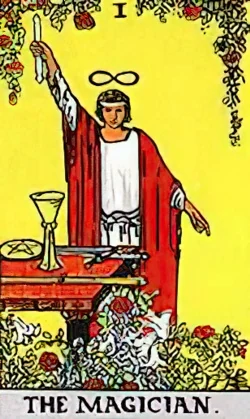
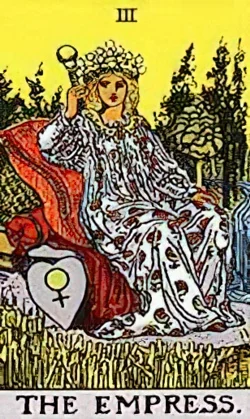
Here is the uncomfortable truth: tarot is not made for yes/no questions. The 78 cards describe layers, interactions, arcs — not a binary switch. Yet for centuries, people have asked exactly this way: "Will he call, yes or no?" This app takes the question seriously and draws three cards whose polarities and energies are condensed into a clear tendency — without the claim of fortune-telling, with the promise of an honest reading.
How three cards become a "yes," "no," or "maybe"
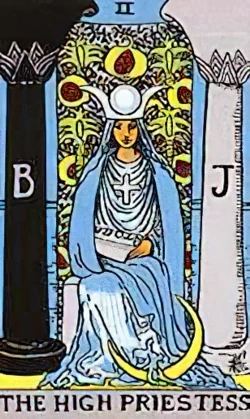
The classic method is surprisingly simple: in an accepted heuristic, every one of the 78 tarot cards has a positive, negative or neutral tonality. Three of Wands is positive (departure, confirmation), Five of Swords is negative (conflict, loss), the High Priestess is neutral (mystery, restraint). When you draw three cards, you tally the tonalities — three positives yield a clear yes, three negatives a clear no, a mix yields tendencies or a maybe.
The AI in this app goes a step further: it does not just count, it reads the order. The middle card carries more weight (it represents the current energy), the first the background, the third the tendency. A reading with positive-positive-negative reads differently than negative-positive-positive: the first is "good start, averted at the end", the second is "difficult start, clearing".
Why yes/no tarot is a paradox
Most experienced readers do not read yes/no tarot. Not out of snobbery, but because the tool is being misused. Tarot shows possibility spaces, energies, interactions — something radically flattened by "yes" or "no". If you ask, "Will I get this job?" and see three positive cards, you do not necessarily get the job — you get the information that the energy around this application is favorable.
Even so, yes/no tarot has its place: it is the entry into tarot for beginners. Whoever is just beginning needs clear answers before they can tolerate complexity. With time you develop the sense that the binary answer usually lies underneath the real question — and you start asking different questions. That is maturation in tarot.
How to get usable answers from yes/no tarot
- Phrase the question precisely and in the here and now. "Will the relationship with X ever work out?" is too vague. "Should I reach out this week?" is answerable. Tarot is good at short time horizons, poor at abstract life questions.
- Accept a "maybe." A reading with mixed cards is no failure of the deck — it is an honest answer that the question is currently in an open phase. Drawing more until a clear yes appears is self-deception.
- If the answer surprises you, do not argue — observe. The most valuable moment in yes/no tarot is the second after the answer: how do I react? Relief at "no"? Disappointment at "yes"? That is the real information.
- Reframe to a three-card reading when the question is deep. Some questions are disguised life themes. "Should I quit, yes or no?" works better as a career tarot reading with "What pulls me, what holds me, what would be the next step?".
FAQ
Why is the answer sometimes unambiguous and sometimes only "maybe"?
Because reality is like that. Tarot reflects the energy you bring into the question — when you yourself are inwardly split, the cards will be split too. A clearly positive reading often says more about your having already decided inwardly than about external circumstances. A "maybe" reading is an invitation to sharpen the question or to wait until the situation clarifies.
Can I ask the same question again the next day?
Yes, but only if something has actually changed — new information, new inner clarity, a new time frame. "Should I send the message tonight?" can be answered differently tomorrow because the day is different. Asking "Will I be happy?" the next day because you did not like the first answer — that only produces frustration and disrespectful readings.
Is yes/no tarot the same as a <a href="/orakel/ja-oder-nein-orakel">yes-or-no oracle</a>?
No, they use different logics. A yes/no oracle usually works with pure probabilities or with a small symbol set (pendulum, coin, three cards in a special deck). Yes/no tarot uses the full 78-card deck and distills its complexity into a binary answer. That is more information, but also more interpretive room. For lightning-fast decisions the oracle is more direct; for questions with more substance, tarot is richer.
Which cards count as "clearly positive" in yes/no readings?
The classics are: The Sun, The World, The Star, The Lovers, Three of Wands, Six of Wands (victory), Ten of Cups (emotional fulfillment), Ten of Pentacles (material fulfillment), Four of Wands (stability, often marriage), Ace of Pentacles (new opportunity). Clearly negative are: The Tower, Three of Swords, Five of Swords, Ten of Swords, Five of Pentacles, Eight of Swords (paralysis). Everything in between — most cards — is context-dependent.
What if I am only seeking confirmation?
It happens to everyone. The temptation to ask the deck until it delivers the desired result is human. A proven practice: before you draw, write down what answer you wish for and which one you fear. If the reading gives you your wished-for answer, examine it especially critically — does it feel substantial, or too smooth? If the reading gives you your feared answer, sit with it for an hour before discarding it. Tarot rewards honesty with yourself, not self-confirmation.
Related