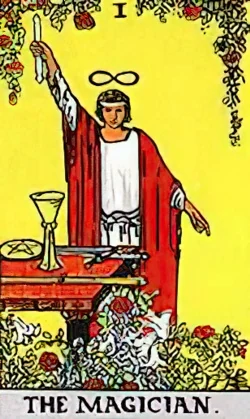
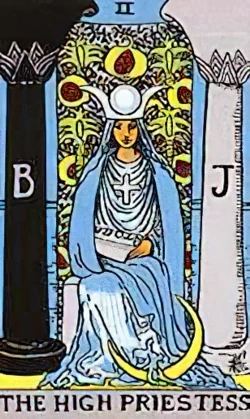
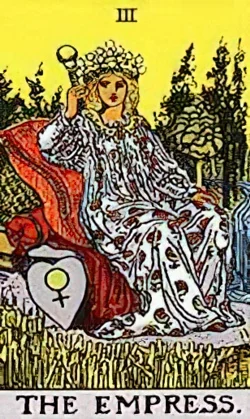
Career decisions are rarely purely rational. You have the spreadsheet, the pros-and-cons list, the conversation with your mentor — and still something feels right or wrong without your being able to name it. This is exactly where the career tarot comes in: not as a substitute for data, but as a tool to make visible the unconscious factors shaping your decision. Three cards, one career question, AI interpretation in seconds.
What career tarot is not — and what it can be
Let us be clear about the limits first. Tarot does not answer technical questions ("Should I learn JavaScript or Python?"), salary negotiations ("How much should I ask for?") or legal matters ("Should I quit or take sick leave?"). For all of that, there are professionals, data and industry knowledge.
What tarot can do: mirror your relationship to work. Are you tired because the job is draining you — or because you do not allow yourself to enjoy it? Is a change due because the industry is shifting — or because you are afraid of standing still? Such layers are hard to capture with Excel, and the tarot exposes them with surprising precision.
What the cards say in a work context
The Pentacles suit (also called Coins) classically speaks of material, money, professional substance. The Eight of Pentacles is the craftsman practicing his art — routine, learning, steady improvement. The Three of Pentacles is teamwork. The Nine of Pentacles is professional independence, often the freelancer profile. The Ten of Pentacles is multigenerational structure: family business, wealth-building, legacy.
The Wands suit (will, energy) shows the other face of work: inspiration, initiative, risk. The King of Wands is the founder, the Knight of Wands the career sprinter, the Queen of Wands the charismatic leader. When your reading shows many Pentacles, the issue is substance and endurance; when many Wands fall, it is departure and risk. A mixture suggests a maturing professional phase in which substance and venture combine.
Concrete applications in working life
- Before a job interview: draw a card and ask, "What do I need to show today, what do I need to hold back?" It is striking how often the card uncovers a blind spot in your own pitch.
- For chronic job exhaustion: draw three cards on "What drains me, what gives me energy, what would be my next step?" The middle card is often the surprise — an aspect you had not seen as energizing.
- Before resigning: do not ask the tarot whether you should quit. That is your decision. Instead ask, "What do I leave behind, what do I take with me?" The cards help complete the separation cleanly.
- Quarterly career check-in: every three months, the same three-card reading on "Where do I stand professionally?" Over a year this yields a remarkably clear career narrative that day-to-day practice loses.
FAQ
Should I consult the tarot before an important career decision?
Use it as a final check, not a first step. Research, conversations with mentors, honest self-reflection first. If you are then still wavering between two options and the gut feeling stays unclear, tarot is useful because it offers an additional format in which the unconscious can speak. Whoever begins with tarot risks shortchanging the rational sources.
What does it mean if I draw "The Tower" or "Death" in a career reading?
In a work context, both are rarely as dramatic as they look. The Tower usually points to a sudden, often overdue change — a restructuring, a conflict coming to light, an old career strategy collapsing. Death in career tarot is almost never literal; it signals the end of one professional phase and the start of the next. Both are uncomfortable, but rarely catastrophic — and they almost never genuinely surprise the person who draws them.
Does career tarot also work for the self-employed and entrepreneurs?
Particularly well, in fact. Self-employed people make decisions every day without a boss to validate them — the tarot becomes a disciplined format for self-questioning. Many solo entrepreneurs use it as a quarterly ritual: three cards on business development, documented across several quarters, yields a narrative arc that is otherwise lost in operations. One variation: combine the career tarot with your
life path number — numerology and tarot complement each other well on career themes.
How does the career tarot reading differ from love tarot?
Main difference: career questions are usually
action-oriented ("What should I do?"), love questions are usually
relationship-oriented ("What is happening between us?"). Tarot helps both, but with a different accent. In
love tarot, the AI reads dynamics between two energies; in career tarot, it reads more in terms of steps, obstacles and resource-strategic questions. Same 78 cards, different lens.
What to do when the reading says the opposite of what I wanted to hear?
For now, nothing. Do not redo the reading on the same day with a reformulated question — that is reframing out of fear, not clarity. Let it stand for a week. Watch what happens at work in that week. In most cases, the unwelcome reading either confirms itself (then you have honest information) or proves outdated (then you have grown). Both outcomes are valuable.
Related