LABORATORY FOR PARAPSYCHOLOGY · EST. 1930

1 / 25
?

Try Extrasensory Perception (ESP) now for free. Online reading with AI interpretation in seconds, no signup required.

Do you have a sixth sense? Do you know who is on the other end of the line before you pick up the phone? Do you dream of events that come true later? The ESP test (extrasensory perception) examines this with the classical methodology of parapsychology: the Zener cards, developed in 1930 at Duke University. You guess the hidden cards — and the statistics show whether your hits exceed chance.

Scientific method meets parapsychology

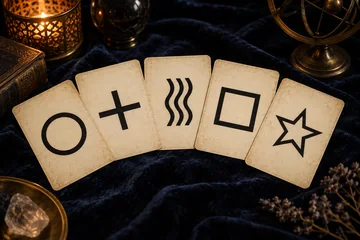
In 1930, the botanist Joseph Banks Rhine and his colleague Karl Zener developed at Duke University a tool intended to lift parapsychology out of the morass of spiritualism into statistics: a deck with only five symbols — circle, cross, waves, square, star — and only five cards per symbol. With purely random guessing, the hit rate is exactly 20 percent (1 in 5). Anyone significantly above that may show signs of extrasensory perception.

This methodology made parapsychology the first esoteric discipline with a real empirical method. Rhine's results were contested for decades — some of his subjects achieved hit rates above 30 percent across thousands of trials, statistically nearly impossible by chance. To this day, the question of whether ESP exists remains open; but the Zener test remains the best available tool for checking your own hit statistics.

How do you read the result?

With 25 cards you expect on average 5 hits (20 percent). 6 or 7 hits are within normal fluctuation. 8 or 9 hits are slightly elevated but not yet significant. From 10 hits it becomes statistically interesting, from 12 hits significant. If you consistently reach 12+ across multiple rounds, you have, by Rhine's methodology, an ESP indicator.

Equally interesting: significantly below chance. Whoever consistently hits only 1 or 2 of 25 deviates just as strongly from chance — some parapsychologists interpret this as "PSI missing", an unconscious avoidance of the right answer. Both deviations from the expected value are indicators of a non-random connection between perception and card.

How the test works

How to test yourself seriously

FAQ

Is ESP scientifically proven?
Academically contested. Daryl Bem's meta-analysis (Cornell, 2011) and the Ganzfeld experiment have shown statistically significant effects, which skeptics explain as methodological errors and other researchers consider real anomalies. The majority of academic psychology considers ESP unproven; a minority (especially at the Rhine Research Center and similar institutions) considers the evidence sufficient to leave the question open. The Zener test is a tool with which you can form your own opinion.
What are the most famous Zener success cases?
Hubert Pearce (a theology student at Duke, 1932) achieved a 32 percent hit rate over 1850 trials — against an expected 20 percent. Adam Linzmayer (Rhine's student, 1931) reached similar results. Both runs were examined by skeptics (Joseph Jastrow, Mark Hansel) for methodological errors, without unambiguously explaining the effect away. These cases are the historical cornerstones of modern parapsychology.
Which form of ESP does the test examine?
Mainly clairvoyance (perception of hidden information without a human sender). If someone else sees the cards and you try to guess them, that would be telepathy. If you guess cards not yet selected, that would be precognition. These three forms are distinguished parapsychologically, but in the Zener test hard to separate, because the algorithm has to choose the "hidden" card.
Why precisely the symbols circle, cross, waves, square, star?
Karl Zener chose them because they are maximally distinguishable — geometrically, semantically, visually — and carry no cultural connotations. Other symbols (animals, letters) would have activated unconscious preferences. The five Zener symbols are as neutral as a symbol set can be. That makes the test cleaner than, say, a card reading — it is purely about the statistical connection between guess and actual card.
Can I train my ESP?
Research is mixed. Some studies suggest slight increases through meditation and relaxation practice. Others show that initial "gifted" subjects lose their hit rate over time ("decline effect"). Practical advice: treat it as a mindfulness game. Even if ESP does not exist as a phenomenon, the test sharpens your attention to intuitive impressions — and that is valuable in everyday life.

Related